
Finding People in San Luis Obispo County
Begin with the fact most likely to be stable. A full name can lead into recorded deeds, liens, fictitious business names, court cases, licenses, or state business filings. An old street address is better handled through the assessor, tax roll, LandUseView, and then the recorder's document history. For a deceased relative, combine office-only death indexes with probate files, obituaries, cemetery records, and deeds recorded after death. Each path answers a different question, so a result should be treated as a lead until another record supports it.
San Luis Obispo County records also reflect local geography. A mailing address may be outside the county even when the person owns land here. A San Luis Obispo postal address may not settle whether a parcel is within city limits or an unincorporated area. Keep the name spelling, middle initial, parcel number, recording number, and case number found at each step. Those details make the next search far more precise.
- Start with a name. Check the Clerk-Recorder index for deeds, liens, trust deeds, reconveyances, and other instruments tied to the person.
- Follow the parcel. Use the assessor and tax systems to compare the property address with the owner's mailing address and assessment history.
- Check a case trail. Search public court information remotely or at a courthouse kiosk, then request copies from the clerk when needed.
- Add life and local records. Use vital indexes, newspapers, directories, and cemetery sources for family history or a past resident.
- Use the right request route. Send a focused California Public Records Act request to the office that keeps a record not available online.
San Luis Obispo County Records Offices
The San Luis Obispo County Clerk-Recorder is the main name-index office. It combines recorded documents, public marriage records, vital-copy services, fictitious business names, elections, and voter-data administration. The Assessor connects people with parcels, while the Superior Court keeps civil, criminal, family, probate, small claims, and other case files. Planning and Building adds address-based permit, land-use, and code records. The Sheriff-Coroner is the keeper for local booking, inmate, arrest, coroner, and related law-enforcement records.
Online search is only one channel. The Clerk-Recorder accepts several copy-request methods for older or certified records. Court users can work through remote access, courthouse kiosks, a counter, mail, and a copy form. Vital-record indexes may require an office visit. Detailed fee, eligibility, and custodian rules belong with the full San Luis Obispo County public records process.
County Clerk-Recorder
1055 Monterey Street, Suite D120
San Luis Obispo, CA 93408
(805) 781-5080
Recorded documents, vital records, FBNs, elections
Superior Court Records
1035 Palm Street, Room 385
San Luis Obispo, CA 93408
Case lookup, courthouse kiosks, mailed copy requests
City Police Records
City of San Luis Obispo reports
(805) 781-7311
Call first to confirm access and fees; reports are not sent by fax or email
San Luis Obispo County Recorder Search
The Clerk-Recorder's Official Records Search is the county's strongest broad public name index. It covers the online index from 1923 to the present, while the office says its official records reach back to 1850. Search modes include name, document number, document type, map book and page, and advanced search. A grantor is the party transferring an interest; a grantee receives it. Those roles help trace a property transfer in either direction.
The Official Records Search landing page shows the available search types and its online coverage notice.
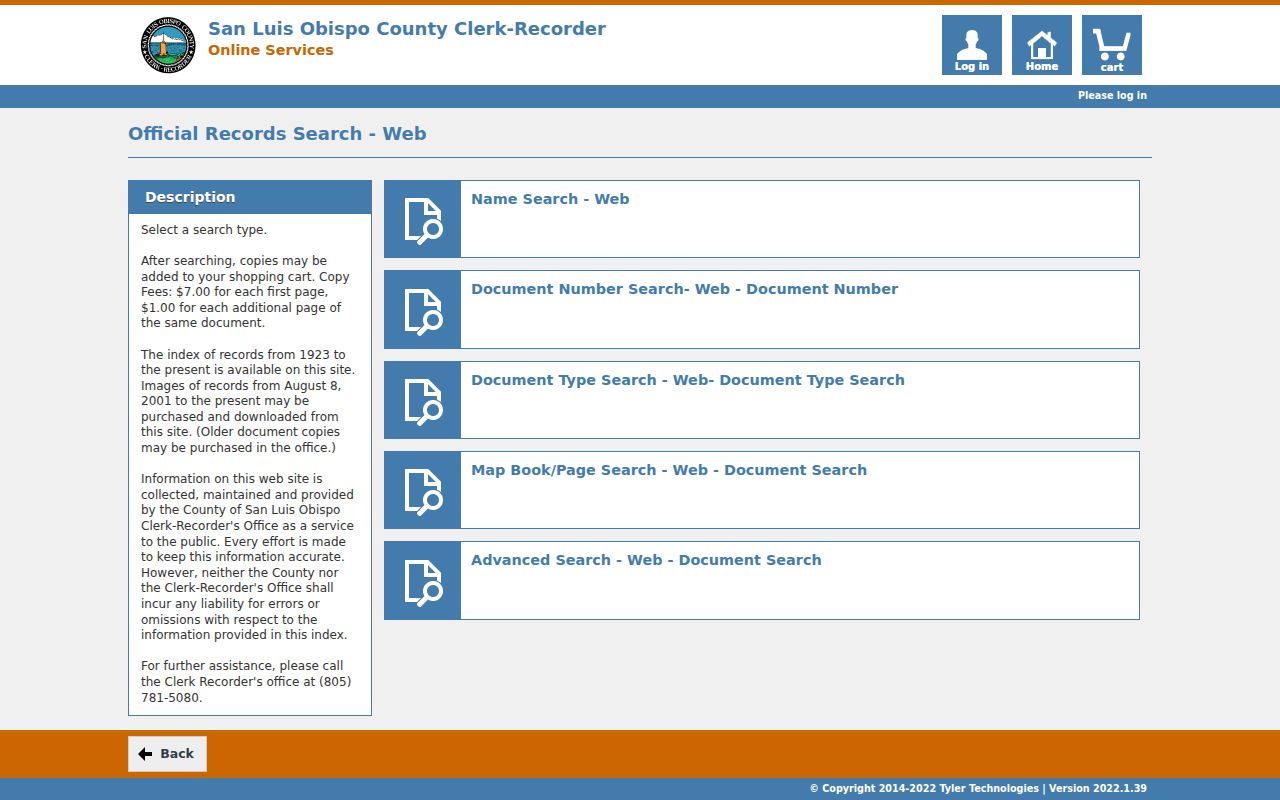
The portal is a free index, but access to document images differs by date. Images from August 8, 2001 onward may be bought and downloaded. Older images and certified copies still require the office or another copy-request channel.
| Recorder field | How to use it | Format or limit |
|---|---|---|
| All Names | Find any indexed party | Enter an individual as last name, then first name |
| Grantor / Grantee | Trace who gave or received an interest | Available in advanced search |
| Recording dates | Narrow a common name | Start and end dates are optional |
| Document number | Open a known filing | Use no commas, spaces, or hyphens |
| Document type | Limit deeds, liens, maps, and other classes | Autocomplete or dropdown |
| Map book / page | Locate a recorded map reference | Book is required for map search |
The portal also documents useful name operators. A dollar sign supports a sounds-like search, an asterisk acts as a wildcard, and a tilde supports fuzzy or proximity searching. Exact quotes work when the name order is certain. These options help with initials, spelling changes, and indexing differences.
San Luis Obispo County Property Trails
A property search can turn an address into an owner name, then connect that name to a longer document chain. The Assessor's Property Inquiry Portal searches at least by assessor parcel number, or APN, and situs address. A situs address is the location of the land itself. The owner's mailing address is where the tax notice goes, and it can point somewhere else. Owner-name and DBA fields appear in the application, though they may require authenticated access.
The Property Inquiry Portal is the direct county source for parcel inquiry.
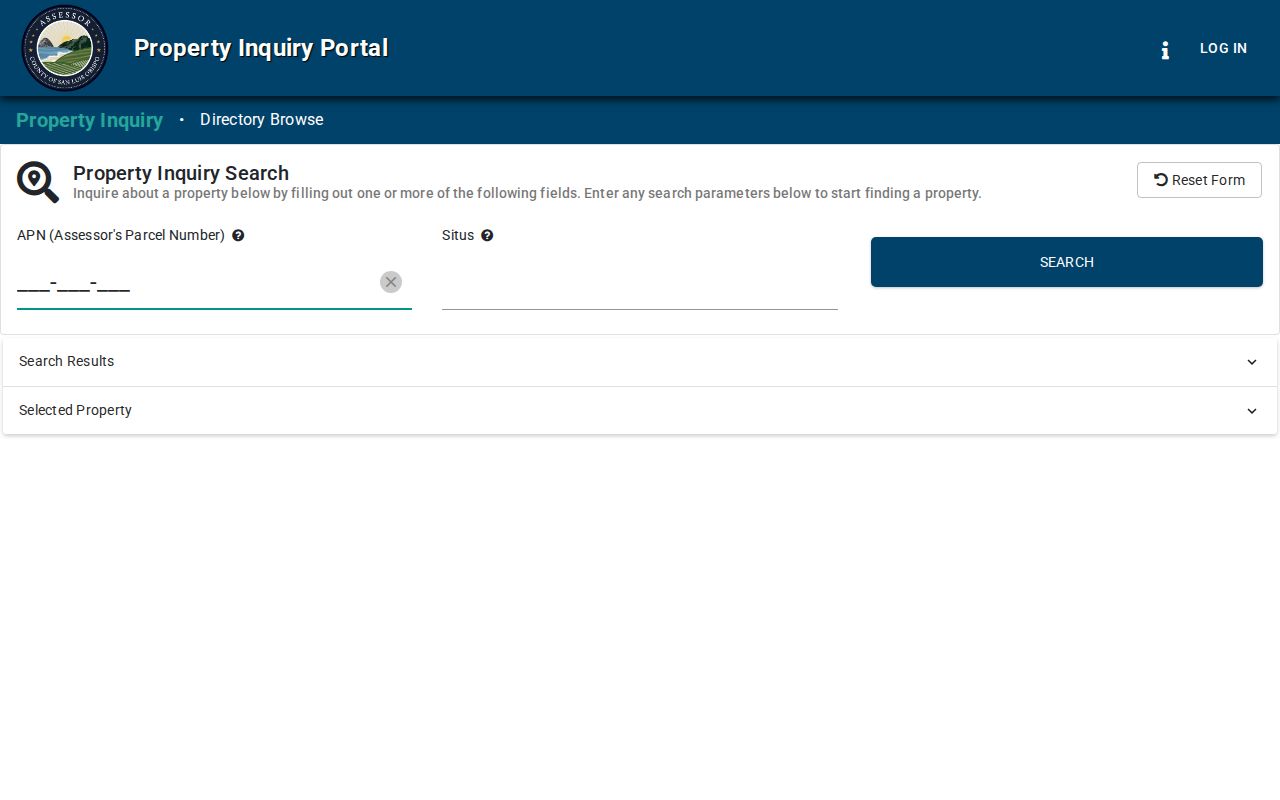
A result can include ownership, roll history, document history, legal description, parcel size, assessed values, exemptions, mailing address, and links into tax and permit systems. Treat a mailing address as a contact lead, not proof that the owner lives there.
For the map view, open the county's LandUseView GIS application.

LandUseView can search by address or parcel number and helps distinguish postal place names, city boundaries, and unincorporated land. That distinction matters across coastal, rural, ranch, and subdivision parcels where an APN or legal description may be more stable than a street address.
Note: Move from address to APN, then assessor owner, recorder filings, and permit history so each step carries a stable identifier.
San Luis Obispo County Court Lookup
The Superior Court of California, County of San Luis Obispo handles the county's state trial matters. Public civil, criminal, probate, family, traffic, and small claims information may appear through re:SearchCA, but remote public users must register. Courthouse kiosks offer an in-person route without remote registration. San Luis Obispo was the first California county to roll out this multi-jurisdiction case-search platform.
The court's Online Case Lookup page explains the remote account and courthouse kiosk choices.
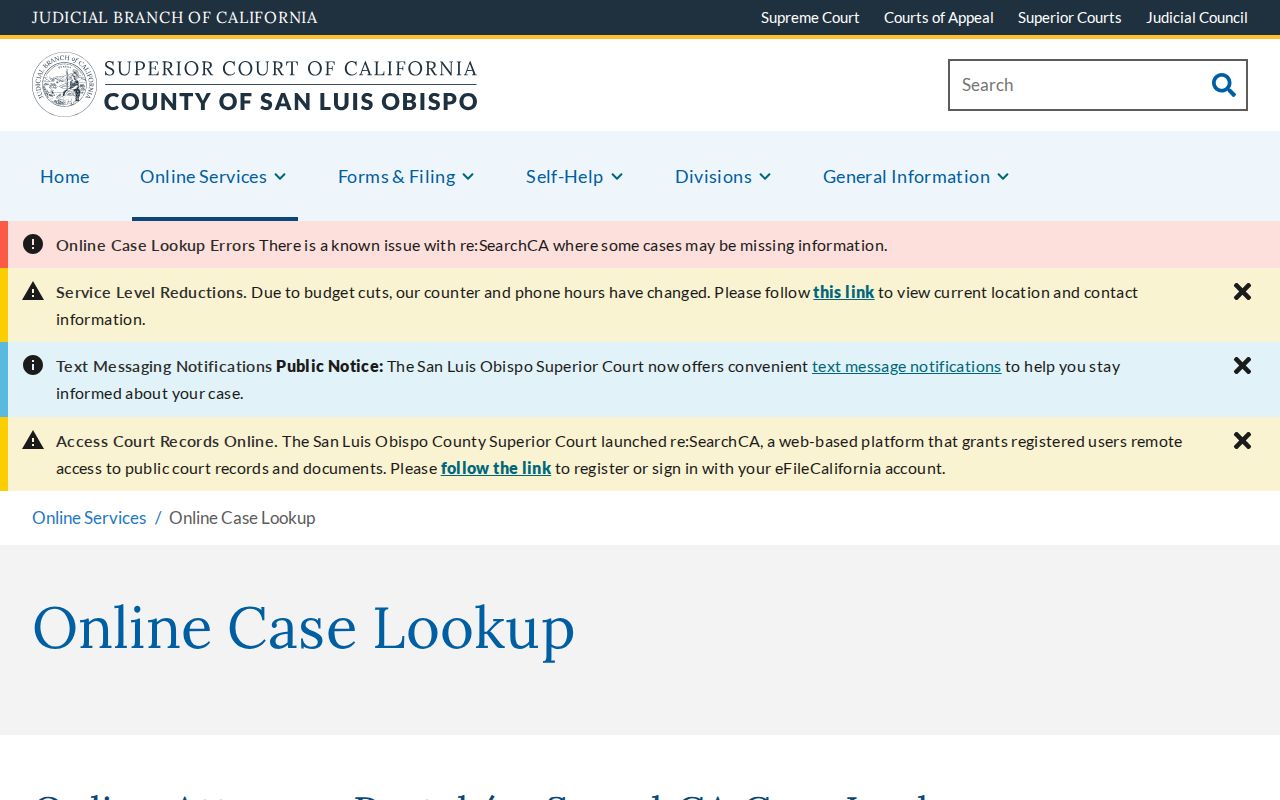
The page also routes users to attorney access separately. Public access remains subject to limits for juvenile, sealed, adoption, and confidential records.
Registered remote users enter through the re:SearchCA public portal.
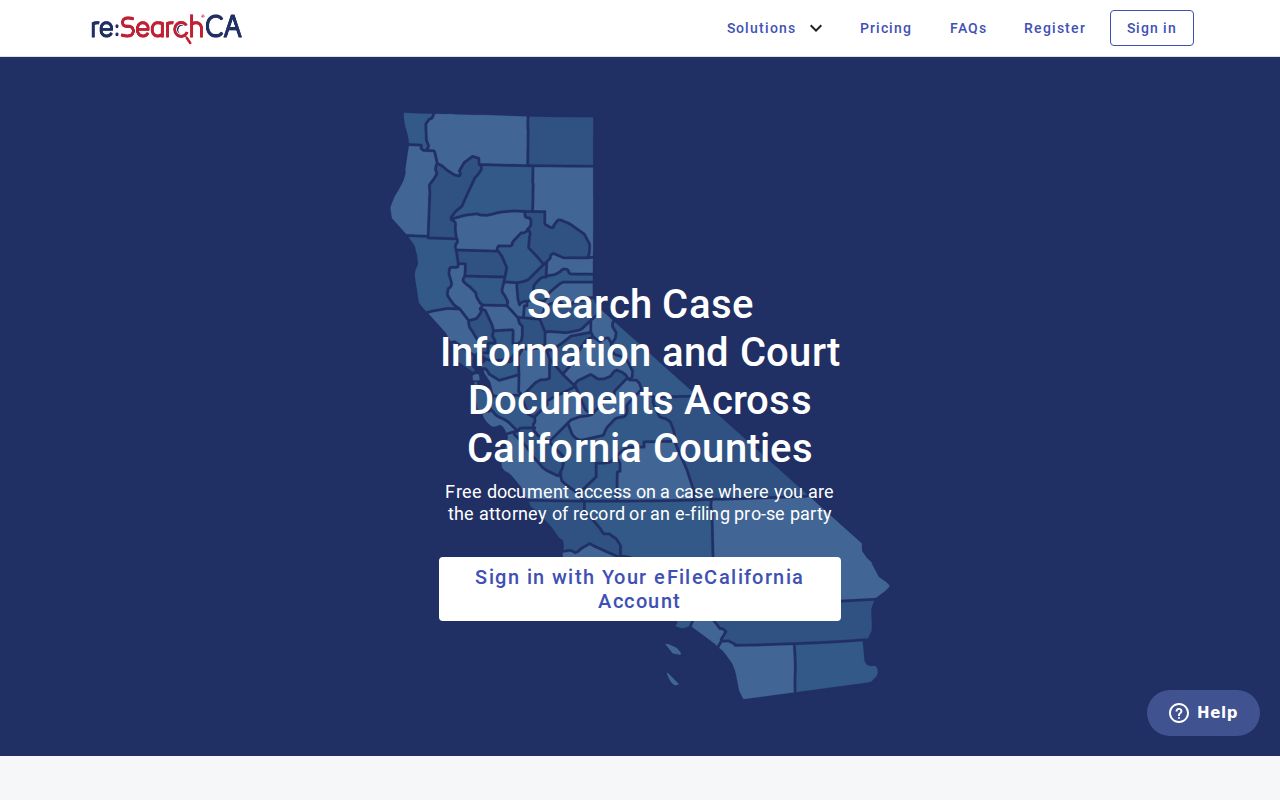
A docket is the chronological register of events in a case. Public results may show a case number, title, party roles, filing date, hearings, actions, disposition, and available documents. Absence online does not prove that no case exists. Pre-2014 criminal name searches may require a written exact-name request, and copies can be ordered at the counter or by mail with the court form.
| Court channel | Best use | Access route |
|---|---|---|
| re:SearchCA | Current public state case information | Remote registration |
| Courthouse kiosk | Public court search without a remote account | In person |
| Copy request | Named documents and certified copies | Counter or mail |
| PACER | Federal district and bankruptcy dockets | Account-based federal access |
San Luis Obispo County Vital Records
The Clerk-Recorder issues certificates for births and deaths that occurred in San Luis Obispo County and for marriages licensed by the county. Death and public marriage records are public records, yet their county indexes are not searchable on the internet. A researcher must visit the San Luis Obispo office, sign in with staff, and use the index there. This is a clear example of public access that remains office-based.
Copy channels include an online application completed at the office within 30 days, in-person lobby kiosks, mail, fax, email, and an expedited third-party order service. Authorized birth, death, and marriage copies are limited to eligible people under California law. A mailed, faxed, or emailed request for an authorized copy requires a notarized sworn statement. Other requesters may qualify for an informational certified copy, which is marked as not valid to establish identity.
- Authorized copy
- A certified copy available to a person within a statutory relationship or legal role and usable to establish identity.
- Informational copy
- A certified copy marked as not valid to establish identity.
- Confidential marriage
- A marriage record generally available only to the spouses or by court order; others may seek an existence letter.
- Divorce decree
- The court's actual judgment, obtained from the Superior Court rather than the state vital-records office.
California Department of Public Health handles statewide copies, but it does not keep confidential marriages. It only issues divorce certificates of record for 1962 through June 1984, not decrees. For local family research, office indexes, obituaries, probate cases, and cemetery files often need to be used together.
San Luis Obispo County Booking Records
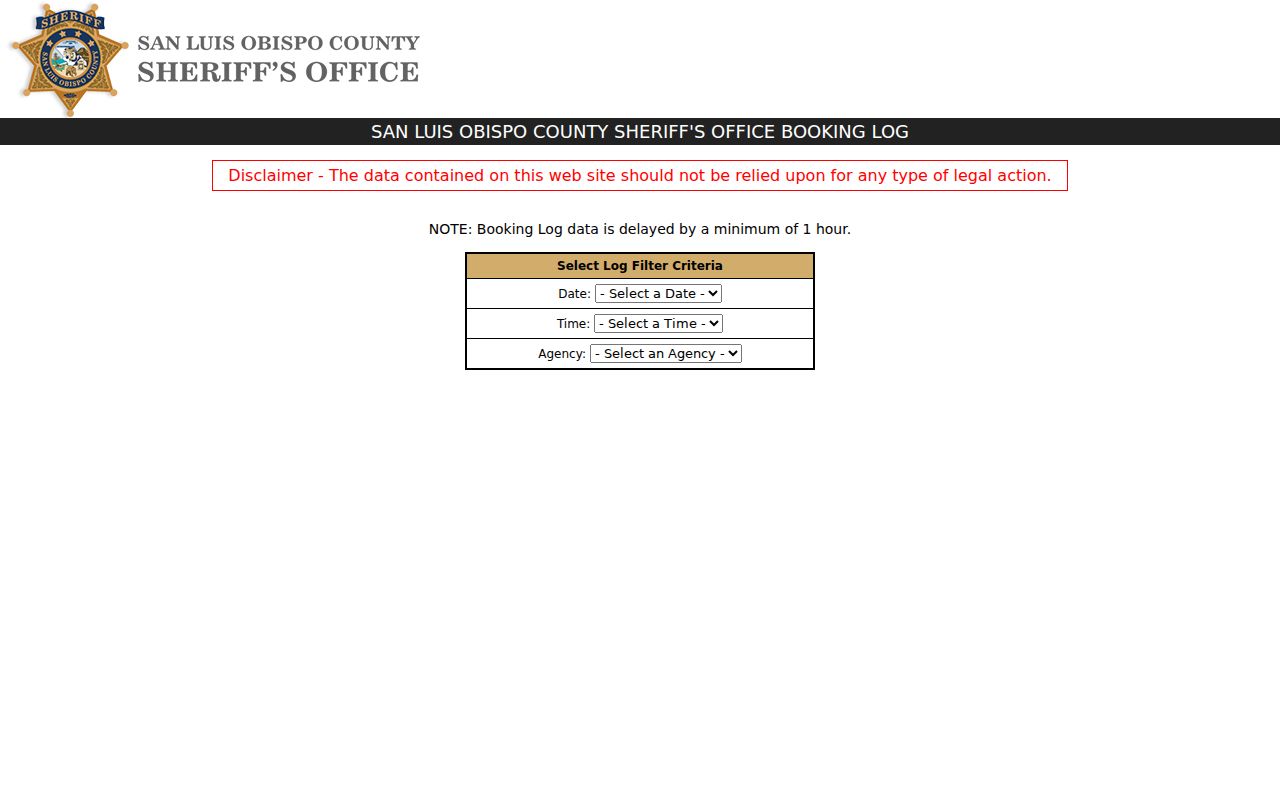
The Sheriff's Office Booking Log is the local current-booking channel. It offers a date filter, and the Sheriff states that data is delayed by at least one hour. The log is not a complete criminal-history search. It reports bookings within its published scope, while court dockets, arrest records, custody files, and state prison information are held in different systems.
The official San Luis Obispo County Booking Log displays the local filter and search screen.
For a record beyond the log, the Sheriff's Department accepts requests for inmate, arrest, custody, coroner, warrant, dispatch, and certain audio or video records. A useful request gives the person's name, date, location, incident or case number, and a clear description. State prison custody is searched separately through California's CIRIS system.
Note: A booking entry records a custody event and should not be treated as proof of guilt or a final court result.
San Luis Obispo County License Search
Business and license records help when a person used a trade name, acted for a company, or held a regulated credential. The Clerk-Recorder's fictitious business name index covers existing, abandoned, and withdrawn filings. Filing images are viewed at the office. California's business search can add an entity status, agent, business address, mailing address, and public filing PDFs. UCC records can be searched by debtor, secured party, or file number.
For regulated occupations, use the California Department of Consumer Affairs License Search.
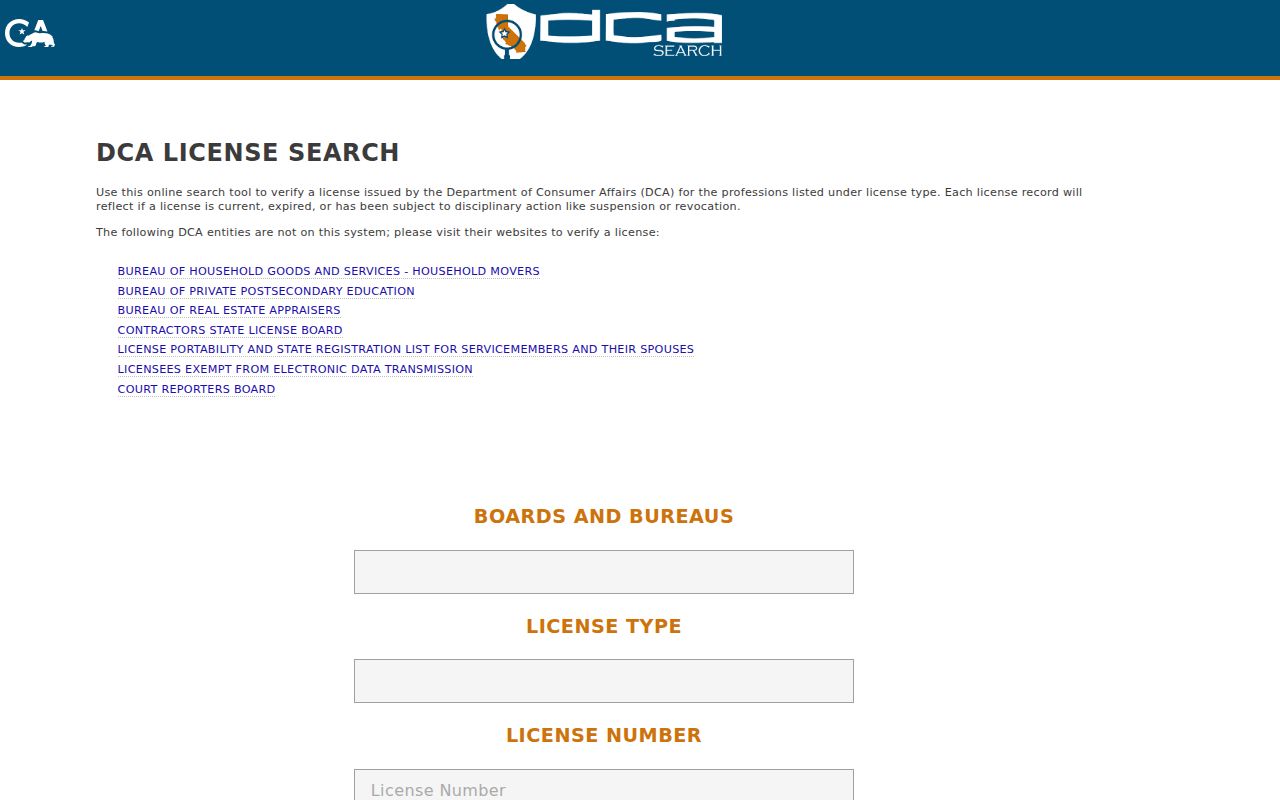
The interface lets users choose a board or bureau, license type, name, license number, and location fields. Results may show whether a license is current or expired and whether public discipline is listed. Some boards maintain separate tools, so follow the board link when a profession is not handled in the central search.
San Luis Obispo County Voter Lookup
California's My Voter Status tool is for a voter to check their own registration. It can confirm registration, name and address, party and language preferences, polling or vote-center details, county contact information, and ballot status. It is not a public directory for looking up another person. San Luis Obispo County points voters to that state service rather than offering a separate county public-name search.
A voter information data file is different. Access requires an approved purpose, a wet-signature application, original initials, a clear ID copy, payment, and security duties. The county does not accept that application by email or fax. Confidential voters and preregistration records for people who are 16 or 17 are excluded, along with signatures, identification numbers, and protected identifiers. The focused San Luis Obispo County voter records explanation covers the application and restricted fields.
Lawful use only. Voter data may not be used for an unapproved purpose, shared without authorization, left unsecured, or used to harass a voter or household.
Three Eras of County Records
San Luis Obispo County was one of California's original counties in 1850, and its official records date to that year. The modern recorder portal is only the newest layer. Think in three eras: images from August 8, 2001 to the present may be purchased and downloaded online; the 1923 to 2001 period has an online index but sends users to copy channels for images; and pre-1923 records require office, archive, or microfilm work.
This split explains why a name may appear in the index while the underlying deed is not on screen. Document number, book and page, party role, and date become the bridge to an offline request. County history also sits outside the recorder. The History Center, Cal Poly, Cuesta College, local libraries, the Genealogical Society, California State Archives, and newspaper collections each preserve a different part of the people trail.
Note: An online cutoff marks a change in access, not the start of record keeping in San Luis Obispo County.
Tracing San Luis Obispo County Residents
Modern restrictions do not end a family-history search. Great Registers, city and county directories, newspapers, obituaries, church records, and cemetery files can place past residents in a year, precinct, trade, family, or neighborhood. Historical voter registers may show a name, age, address or precinct, occupation, birthplace, naturalization facts, and registration status, depending on the year. They are a historical source, not a substitute for today's regulated voter file.
The county's past-resident trail is spread among many keepers. The History Center's online collections provide Quick Search, Advanced Search, Browse, Archives, Library, and Photos. The 1901 San Luis Obispo City and County Directory has a Cal Poly archive record. The California Digital Newspaper Collection supplies searchable historic papers with names in legal notices, probate items, land sales, obituaries, advertisements, and social columns.
Use cemeteries by district as well as by city. San Luis Obispo County has eleven public cemetery districts, and their boundaries do not neatly follow city lines. Mission church burial records and obituary indexes are especially useful because county death records are not available through a public web index.
San Luis Obispo County Request Routes
When no portal provides the needed record, send the request to its actual custodian. The county's PRA/Data Requests routing material separates Sheriff records, Clerk-Recorder records, Planning and Building files, Public Works data, and Environmental Health materials. California's Public Records Act covers nonexempt writings about public business, regardless of physical form. The agency generally has 10 days to determine whether responsive records are disclosable, with a written extension of up to 14 days for unusual circumstances.
A formal written request is not required by the county, but clear writing helps. Give names with spelling variants, a date range, location, case or incident number, APN, document number, and the type of record sought. Ask for electronic records when that format works. If the request reaches the wrong office, use the routing table rather than sending the same broad request to every department.
Offline channels matter throughout San Luis Obispo County. Recorder copies can move through the counter, mail, email, or fax depending on the record. Court copies use the counter or mail form. Vital records add office kiosks and several application routes. Police reports within the City of San Luis Obispo start with a phone call because the city does not release those reports by fax or email.
California Privacy in Local Searches
Public access has firm boundaries. Voter releases omit driver license and state ID numbers, partial Social Security numbers, unique identifiers, and signatures. Protected voters are excluded. Vital records distinguish authorized and informational copies. Juvenile, sealed, adoption, and confidential court records are not opened merely because a name is known. Military discharge copies also have statutory limits.
California Safe at Home supplies a substitute mailing address for qualifying survivors and certain protected workers. Public agencies generally must accept that designated address, and eligible participants may seek replacement or redaction of a home address on certain real-property documents. Official public records cannot usually be removed just because someone prefers less visibility. A statute, court order, redaction rule, or confidentiality program must apply.
California residents also have privacy rights concerning covered businesses and registered data brokers. The statewide DROP system launched in 2026 as a single deletion-request route for active data brokers. That process concerns commercial data copies, not the original county deed, case, or assessment record.
Choosing Reliable San Luis Obispo Records
Official systems and commercial people-finder services do different work. County and state records identify a custodian, record type, date, and access rule. Commercial compilations may merge public records with marketing or brokered data, but their identity matches and update cycles can be unclear. Start with official sources when accuracy, context, or a copy of the underlying record matters.
| Source type | Strength | Limit |
|---|---|---|
| Recorder, assessor, or court | Direct custodian and record context | Some images, copies, or files require an account, fee, or office visit |
| Library or historical archive | Older residents, families, local events, and address history | Holdings are split across repositories and may need staff help |
| Commercial compilation | Broad starting point | May combine stale data or link the wrong people |
Verify an identity with two independent facts, such as a name plus APN, a deed number plus mailing address, or a case number plus filing date. Use all people-search records for lawful personal research. Never use a record to stalk, threaten, harass, or harm another person.